Newton's Third Law
Unit: Force and Newton's Laws
Prerequisites
Lesson Preview
Newton's Third Law states that whenever one object exerts a force on a second object, the second object exerts an equal and opposite force back on the first. These two forces are called an action-reaction pair.
Mathematically, if object A exerts force on object B, then object B simultaneously exerts force on object A:
The negative sign indicates the forces point in opposite directions. The magnitudes are equal: .
Key characteristics: The two forces always act on different objects (one on A, one on B), are the same type of force (both contact, or both long-range), and exist simultaneously. Because action-reaction pairs act on different objects, they never both appear on the same free body diagram.
Example: Two blocks in contact
Consider two blocks, A and B, in contact on a horizontal surface. Block A pushes on Block B with horizontal force to the right. By Newton's Third Law, Block B pushes back on Block A with horizontal force to the left.
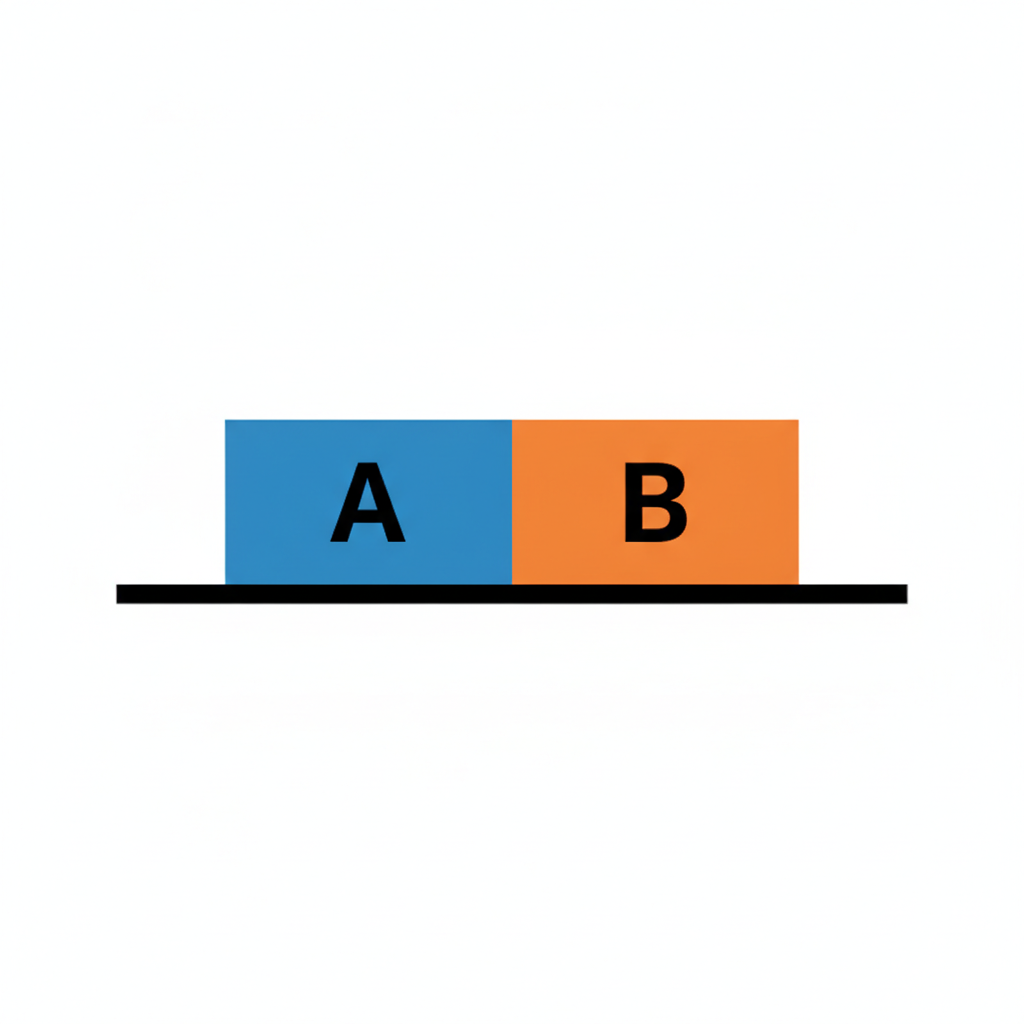
Note: The free body diagrams below show only the horizontal force components acting on each block. Free body diagram for Block B only (horizontal forces):
Free body diagram for Block A only (horizontal forces):
... continued in the full lesson.
Ready to Start Learning?
Sign up now to access the full Newton's Third Law lesson and our entire curriculum!