Connected Objects
Unit: Force and Newton's Laws
Prerequisites
Later Topics
Lesson Preview
When two objects are connected by a rope or in direct contact, they often move together with the same acceleration. This shared motion is the key constraint.
Draw separate free body diagrams (FBDs) for each object. Each object has its own forces—gravity, normal forces, tension, friction, etc.—but the connection ensures they accelerate together. For objects connected by a rope or moving together, the accelerations are equal: .
Example: Two masses and are connected by a rope. A force pulls mass , so both masses accelerate together with the same .
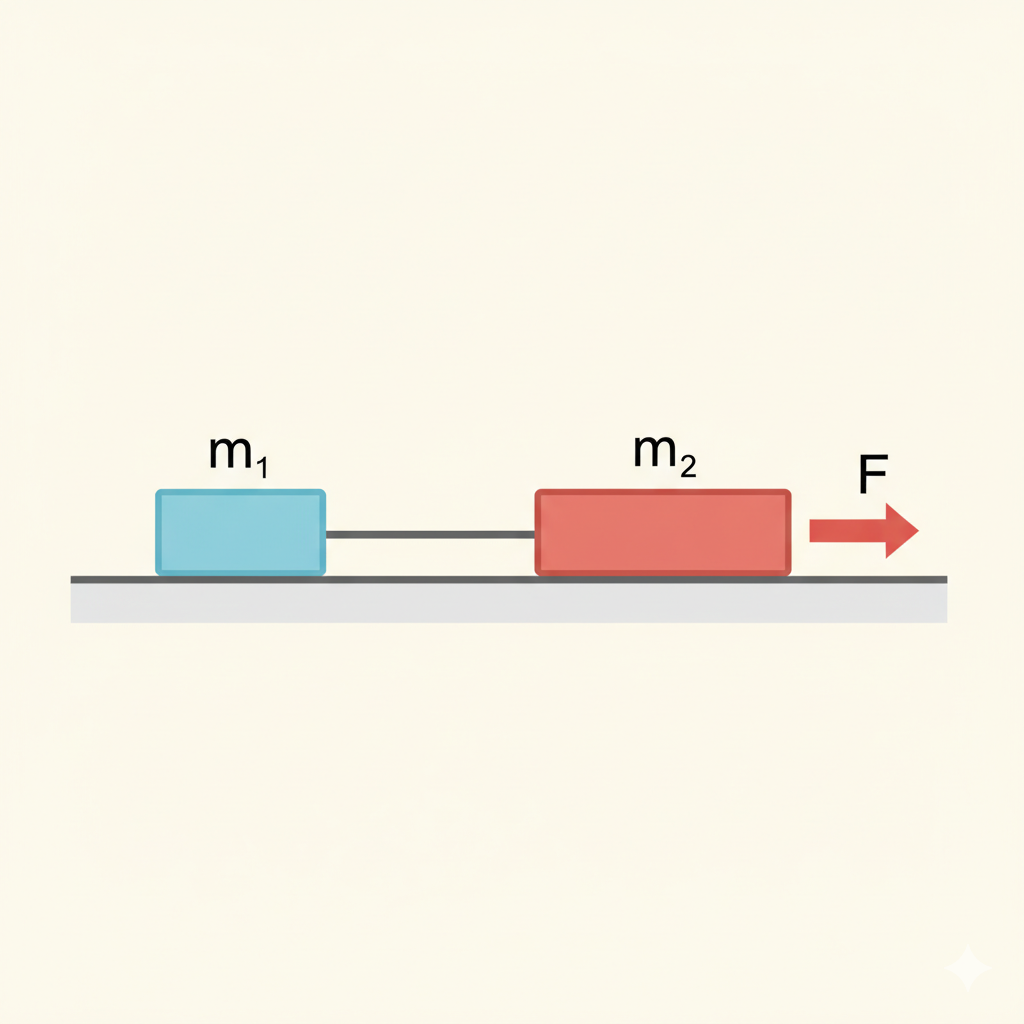
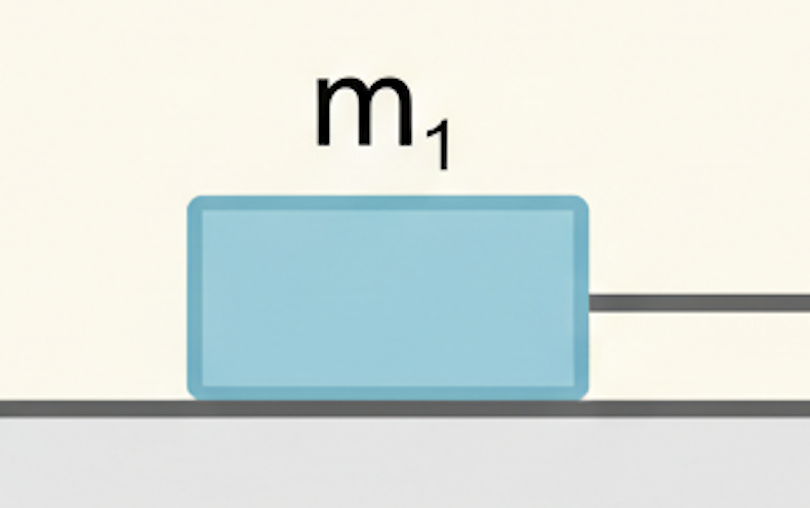
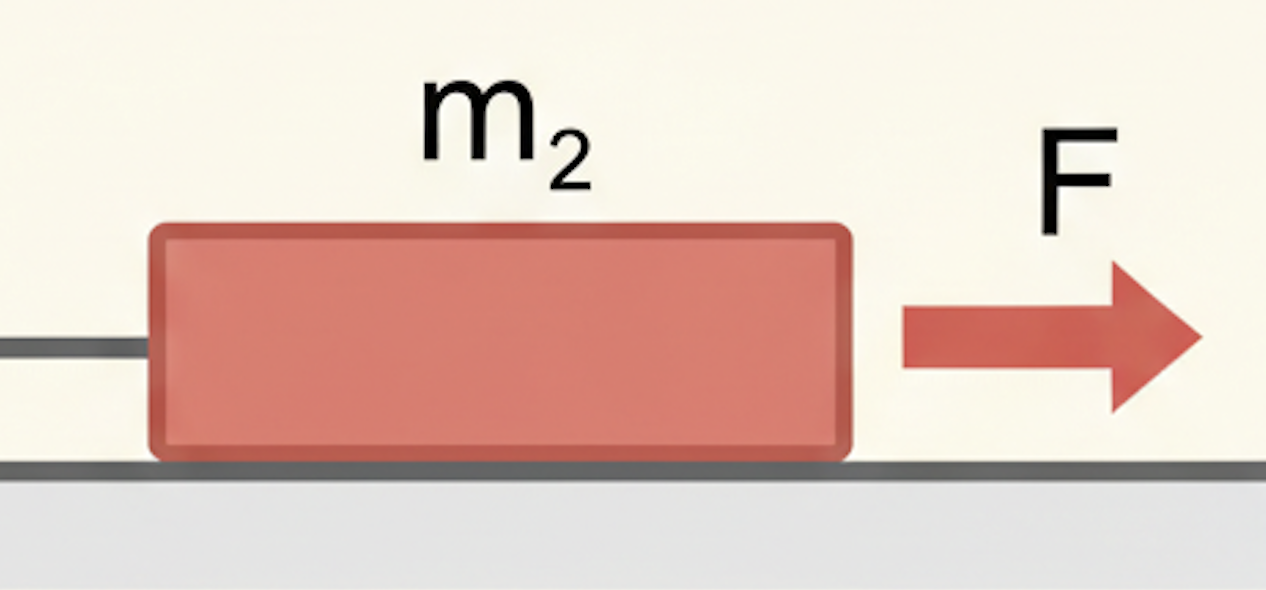
Mass (on the left) experiences only tension from the rope pulling it forward. Mass (on the right) experiences the applied force pulling it forward and tension from the rope pulling it backward. The constraint connects the two diagrams and lets you solve for tension and acceleration.
Let's examine both masses separately first:
Mass 1:
Mass 2:
System vs Individual Approach:
You can analyze each mass separately or treat the connected objects as a single system. When analyzing separately, you apply Newton's second law to each object: and . These equations involve the internal force (tension or contact force).
Treating them as a system eliminates internal forces like because they are equal-and-opposite pairs (Newton's third law). Applying Newton's second law to the whole system gives:
.
This directly gives acceleration .
FBD for Combined System:
... continued in the full lesson.
Ready to Start Learning?
Sign up now to access the full Connected Objects lesson and our entire curriculum!