Newton's Law of Universal Gravitation
Unit: Uniform Circular Motion and Gravitation
Prerequisites
Lesson Preview
Newton's Law of Universal Gravitation states that every particle attracts every other particle with a force directly proportional to the product of their masses and inversely proportional to the square of the distance between their centers.
Gravitational force has two key properties:
Gravity is always attractive. Unlike electric forces, gravity only pulls objects together. There is no gravitational repulsion. Two masses and always pull toward each other.
Gravity acts along the line joining the centers of mass. The force on each object points directly toward the center of the other object. For spherical objects like planets, we can treat all mass as concentrated at the center.
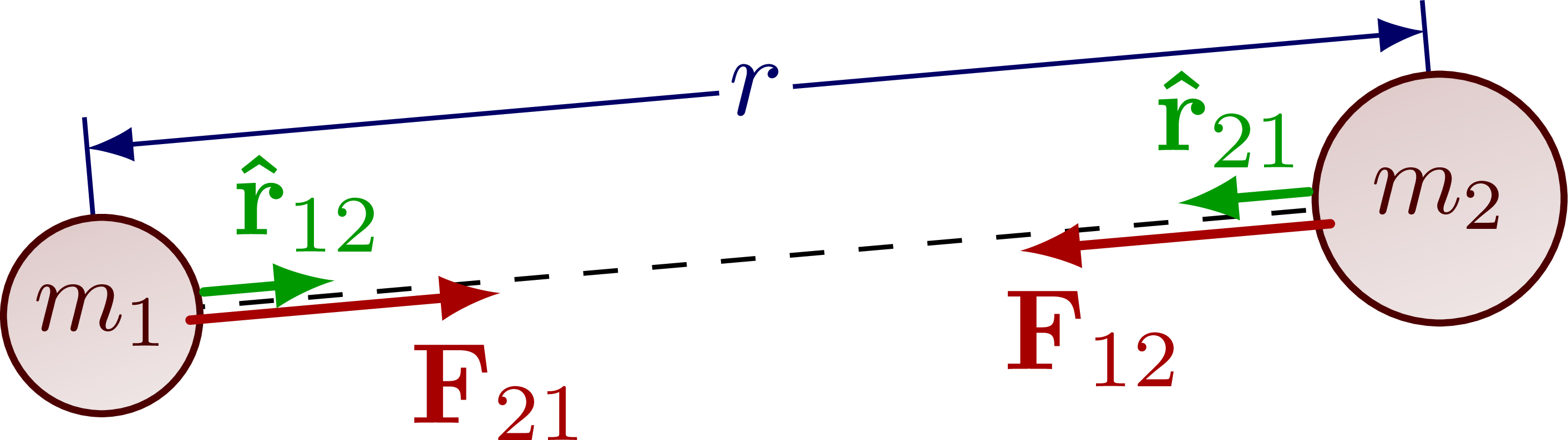
The diagram shows two masses separated by distance . Mass experiences force (force on due to ) pointing toward . Mass experiences force (force on due to ) pointing toward .
...
... continued in the full lesson.
Ready to Start Learning?
Sign up now to access the full Newton's Law of Universal Gravitation lesson and our entire curriculum!