Addition, Subtraction, and Scalar Multiplication of Real N Dimensional Vectors (R^n)
Unit: Vectors
Lesson Preview
There is nothing stopping us from writing down vectors of higher dimension than 2. For example:
are examples of -dimensional and -dimensional vectors respectively.
is the "vector space" of -dimensional vectors (vectors with 3 real-number entries). is the "vector space" of -dimensional vectors (vectors with 4 real-number entries). And is the "vector space" where -dimensional vectors with real-number entries live.
We won't give the precise definition of vector spaces here, but for our purposes, it is enough to think of them as the homes where vectors live, where all the rules for adding, subtracting, scalar multiplication, and taking linear combinations that applied in generalize in a straightforward way.
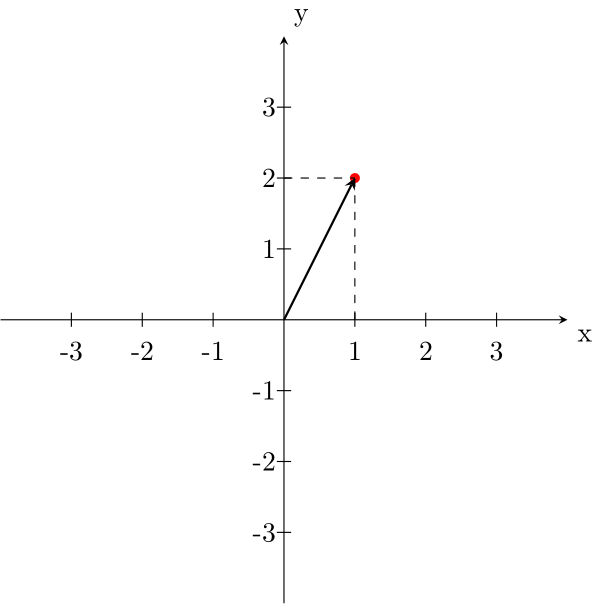
Note in , vectors had a straightforward interpretation, i.e. a vector , for example, can be viewed as an arrow pointing “1 unit” in the -direction and “2 units” in the -direction:
But what does a vector in represent?
...
... continued in the full lesson.
Ready to Start Learning?
Sign up now to access the full Addition, Subtraction, and Scalar Multiplication of Real N Dimensional Vectors (R^n) lesson and our entire curriculum!