← Back to course overview

Addition, Subtraction, and Scalar Multiplication of Real 2D Vectors (R^2)

Unit: Vectors

Lesson Preview

Suppose we have two vectors v=[13]\vec{v} = \begin{bmatrix} 1 \\ 3 \end{bmatrix} and w=[42]\vec{w} = \begin{bmatrix} 4 \\ 2 \end{bmatrix}.

What is the meaning of v+w\vec{v} + \vec{w} and how do we calculate it?

Visually, we can add vectors tip-to-tail as such:
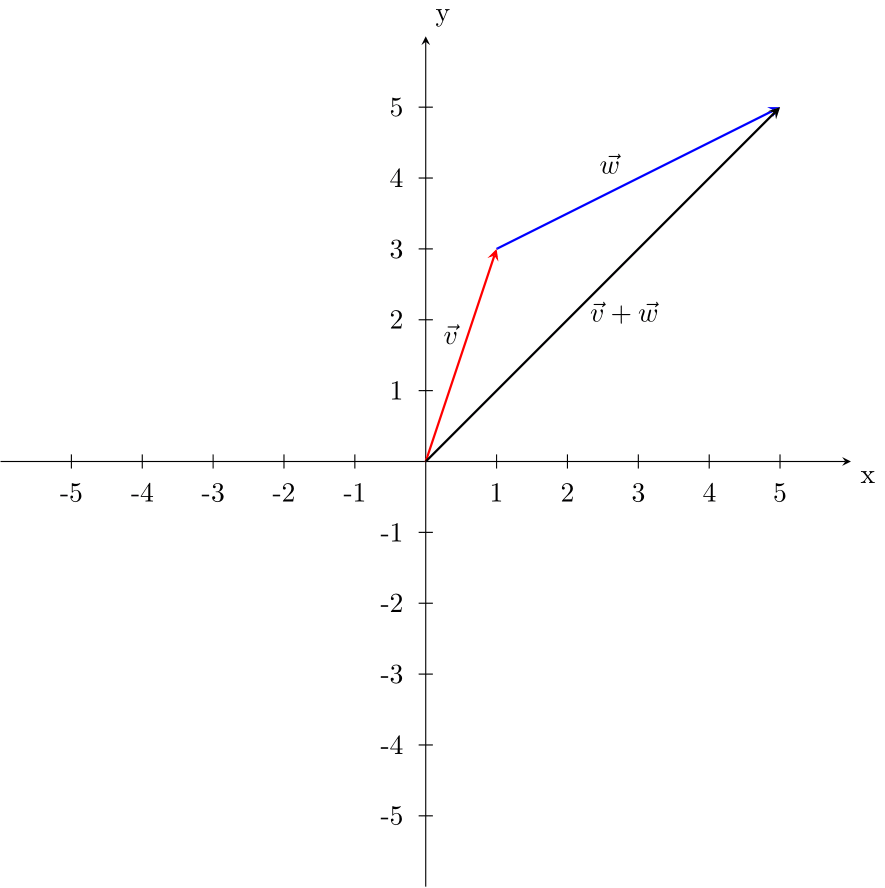
Vector addition

We can see from the plot that v+w= [55]\vec{v} + \vec{w} =  \begin{bmatrix} 5 \\ 5 \end{bmatrix}

Mathematically, we add vectors component by component, i.e.

v+w =[13]+ [42]=[1+43+2] =[55].\begin{align*} \vec{v} + \vec{w}  &= \begin{bmatrix} 1 \\ 3 \end{bmatrix} +  \begin{bmatrix} 4 \\ 2 \end{bmatrix} \\ &= \begin{bmatrix} 1 + 4 \\ 3 + 2 \end{bmatrix}  \\ &= \begin{bmatrix} 5 \\ 5 \end{bmatrix}. \end{align*}

In general, for vectors v=[v1v2]\vec{v} = \begin{bmatrix} v_1 \\ v_2 \end{bmatrix} and w=[w1w2]\vec{w} = \begin{bmatrix} w_1 \\ w_2 \end{bmatrix} we have:

v+w =[v1v2]+ [w1w2]=[v1+w1v2+w2 ].\begin{align*} \vec{v} + \vec{w}  &= \begin{bmatrix} v_1 \\ v_2 \end{bmatrix} +  \begin{bmatrix} w_1 \\ w_2 \end{bmatrix} \\ &= \begin{bmatrix} v_1 + w_1 \\ v_2 + w_2  \end{bmatrix}. \end{align*}

...

... continued in the full lesson.

Ready to Start Learning?

Sign up now to access the full Addition, Subtraction, and Scalar Multiplication of Real 2D Vectors (R^2) lesson and our entire curriculum!