← Back to course overview
Dot Product Applications (in R^2 and R^n)
Unit: Vectors
Prerequisites
Later Topics
Lesson Preview
In -D, if two vectors are perpendicular with each other, i.e., the angle between them is , we say they are orthogonal.
For example, consider the vectors
We have:
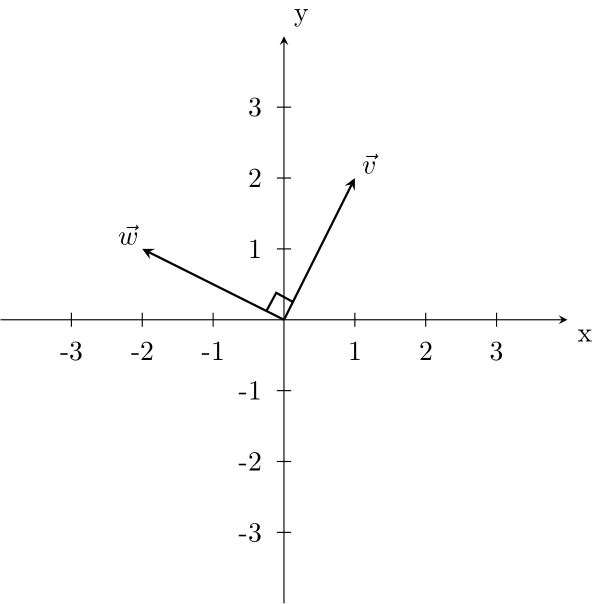
Since between and , notice from the dot product formula we have:
and so,
since .
In higher dimensions, we actually use this condition to define two vectors being orthogonal.
That is: for two -dimensional vectors,
... continued in the full lesson.
Ready to Start Learning?
Sign up now to access the full Dot Product Applications (in R^2 and R^n) lesson and our entire curriculum!