Centripetal Acceleration
Unit: Uniform Circular Motion and Gravitation
Prerequisites
Lesson Preview
Why Circular Motion Requires Acceleration
When an object moves in a circle at constant speed, it is still accelerating. Velocity is a vector—it has both magnitude and direction. In circular motion, the speed is constant but the direction continuously changes. The velocity is always tangent to the circle.
Watch the ball moving in a circle. Notice how its velocity direction constantly changes. Try cutting the string—the ball flies off tangent to the circle.
By Newton's first law, the ball would continue in a straight line unless something pulls it inward. The string provides this inward pull, causing the ball to accelerate toward the center and follow the circular path.
Similarly, when riding in a car around a curve at steady speed, you feel pushed toward the outside. This happens because your body tends to continue straight while the car turns inward. Something must accelerate you inward—friction from your seat or a seatbelt.
Finding the Direction of Acceleration
Consider two nearby points and on a circular path with center at :
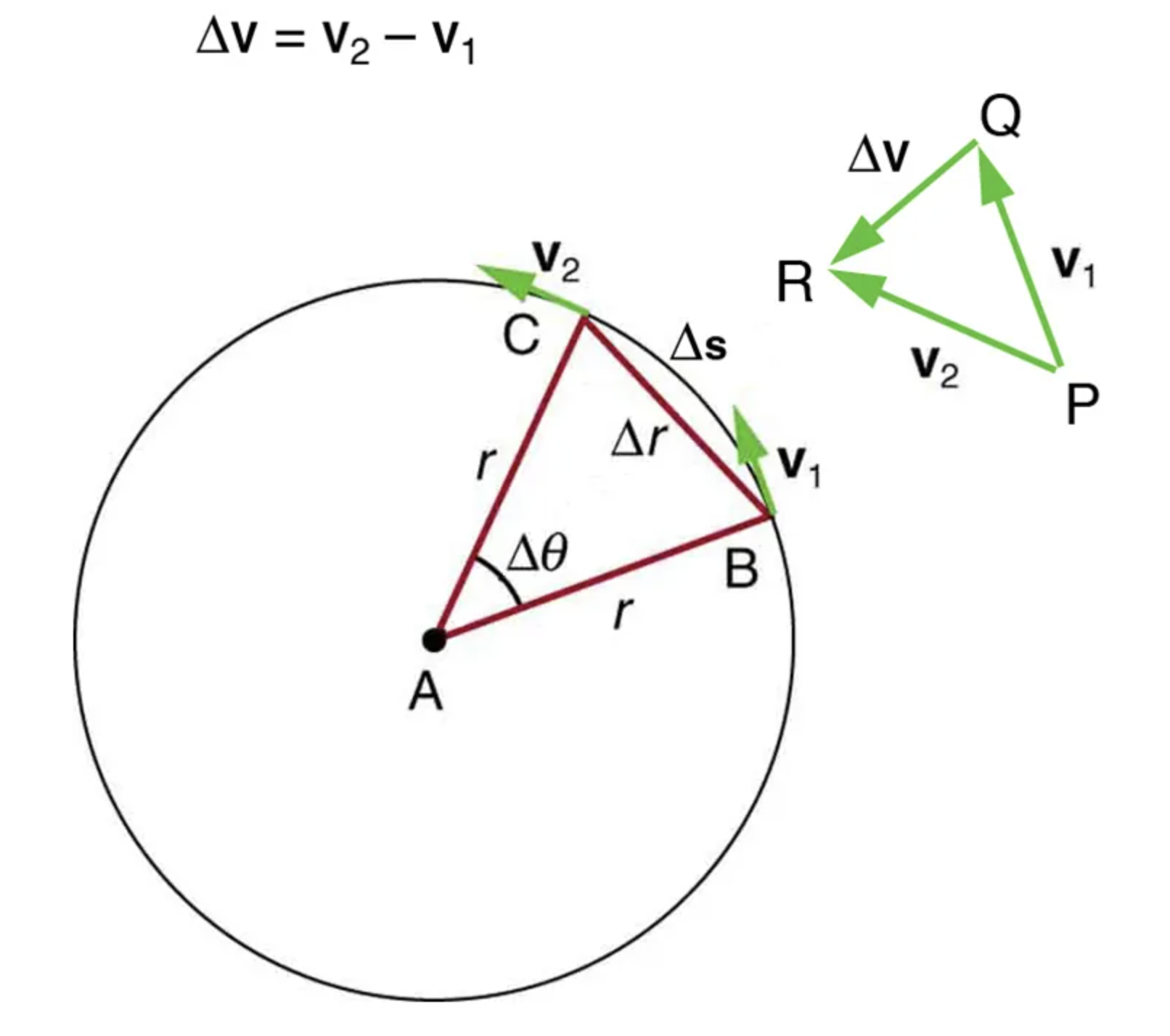
At point , the velocity is (tangent to the circle).
...
... continued in the full lesson.
Ready to Start Learning?
Sign up now to access the full Centripetal Acceleration lesson and our entire curriculum!