Centripetal Force
Unit: Uniform Circular Motion and Gravitation
Prerequisites
Lesson Preview
A common misconception is that "centripetal force" is a new type of force that exists alongside tension, friction, gravity, etc. In reality, centripetal force is simply the name we give to the net force pointing toward the center of a circular path. It describes the role a force plays, not a distinct force itself.
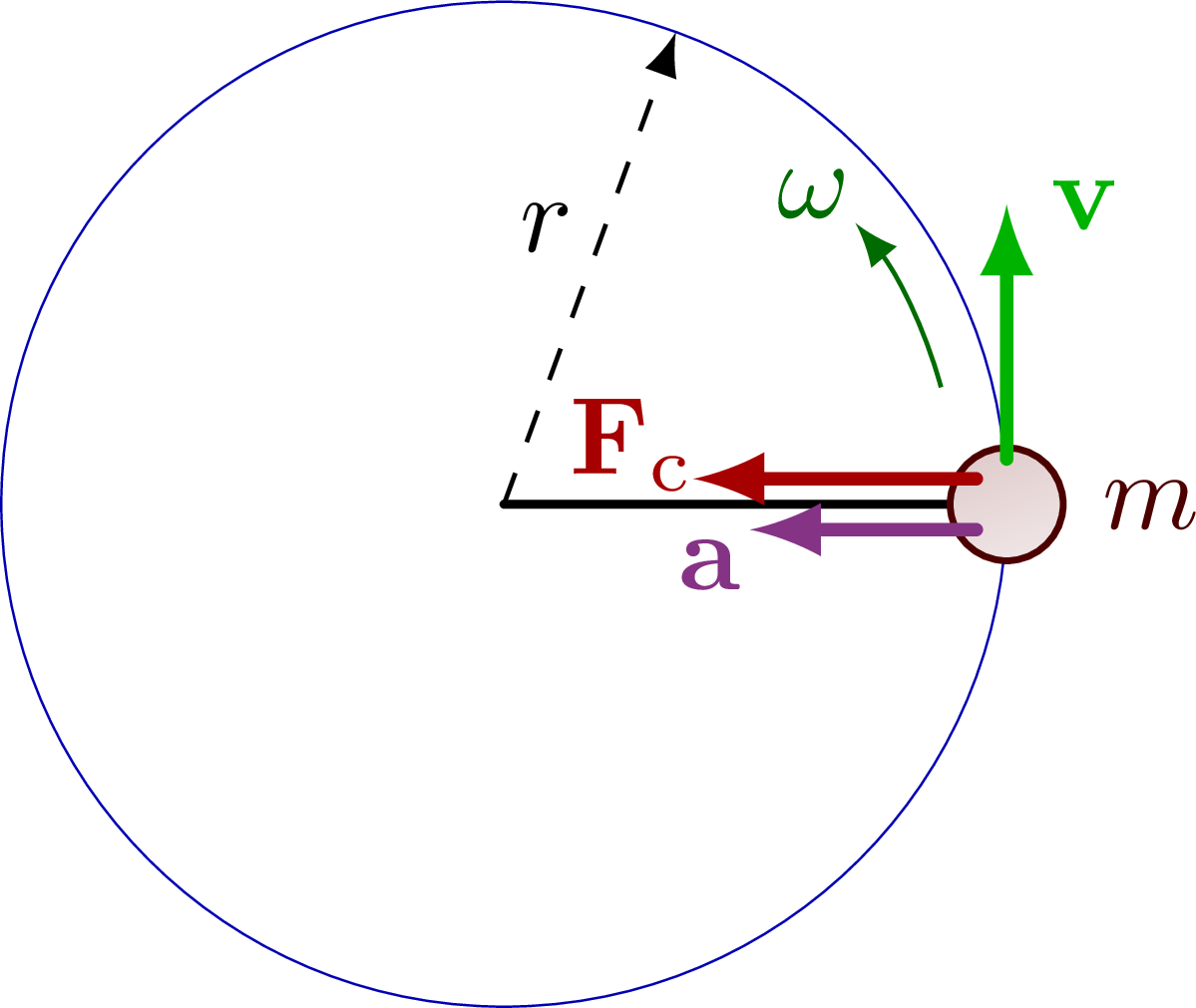
When an object moves in a circle, it experiences centripetal acceleration directed toward the center. By Newton's second law, this acceleration requires a net force:
This net force must point toward the center. The centripetal force is this net force—it's provided by real, physical forces like tension, friction, gravity, or normal forces.
Consider a ball whirling on a string. The string exerts tension on the ball, pointing toward the center. If tension is the only force in the radial direction, then the net force is simply . We call this net force the centripetal force: . We don't add an additional "centripetal force" to our free body diagram—that would double-count the same force.
... continued in the full lesson.
Ready to Start Learning?
Sign up now to access the full Centripetal Force lesson and our entire curriculum!