Introduction to Energy
Unit: Work, Energy, and Power
Prerequisites
Later Topics
Lesson Preview
Energy is the capacity of a system to cause change. Energy exists in many different forms, and understanding these forms is the first step in analyzing physical processes.
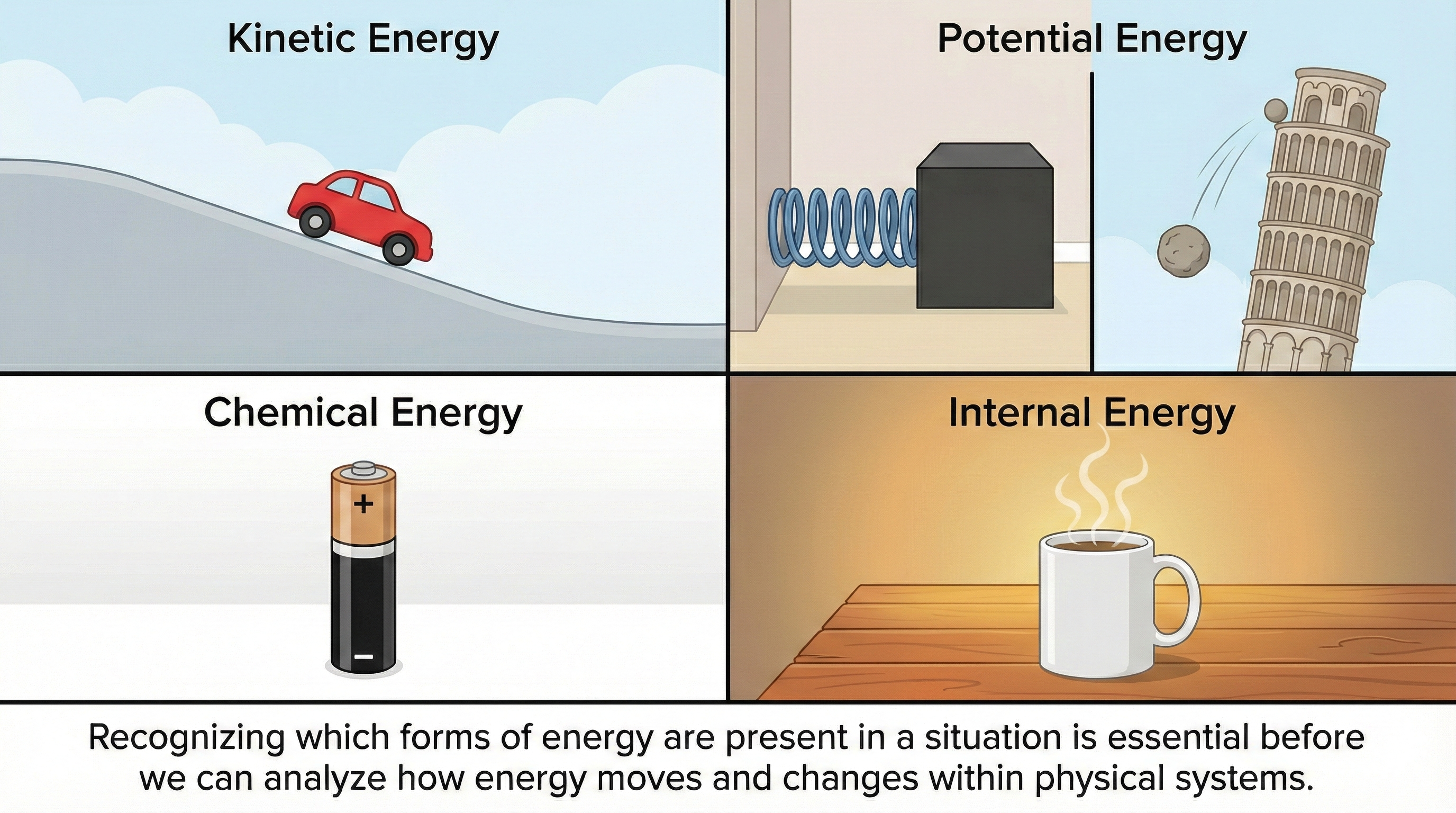
Kinetic energy is the energy of motion. A rolling ball, a flying airplane, and a spinning top all possess kinetic energy because they are moving. The faster an object moves or the more massive it is, the more kinetic energy it has.
Potential energy is stored energy due to position or configuration. An object held above the ground has gravitational potential energy—the higher it is, the more potential energy it stores. A compressed or stretched spring stores elastic potential energy. Potential energy represents the capacity to do something in the future because of where something is or how it's arranged.
Chemical energy is stored in the bonds between atoms and molecules. Food, gasoline, batteries, and firewood all contain chemical energy. When chemical reactions occur, this stored energy can be released and transformed into other forms.
Internal energy is the microscopic kinetic and potential energy of the countless atoms and molecules inside a substance. We experience internal energy as temperature—hotter objects have more internal energy because their molecules are moving faster and vibrating more vigorously.
Energy constantly transforms from one form to another.
...
... continued in the full lesson.
Ready to Start Learning?
Sign up now to access the full Introduction to Energy lesson and our entire curriculum!