Bowling Ball Down a Slick Lane
Unit: Energy and Momentum of Rotating Systems
Prerequisites
Later Topics
Multi-Step Problem Preview
Part 1 of 6 — sign up to solve the full problem!
Part 1
A bowling ball of mass and radius (modeled as a solid sphere with moment of inertia ) is bowled down a lane with initial linear velocity and no spin (). The coefficient of kinetic friction between the ball and the lane is .
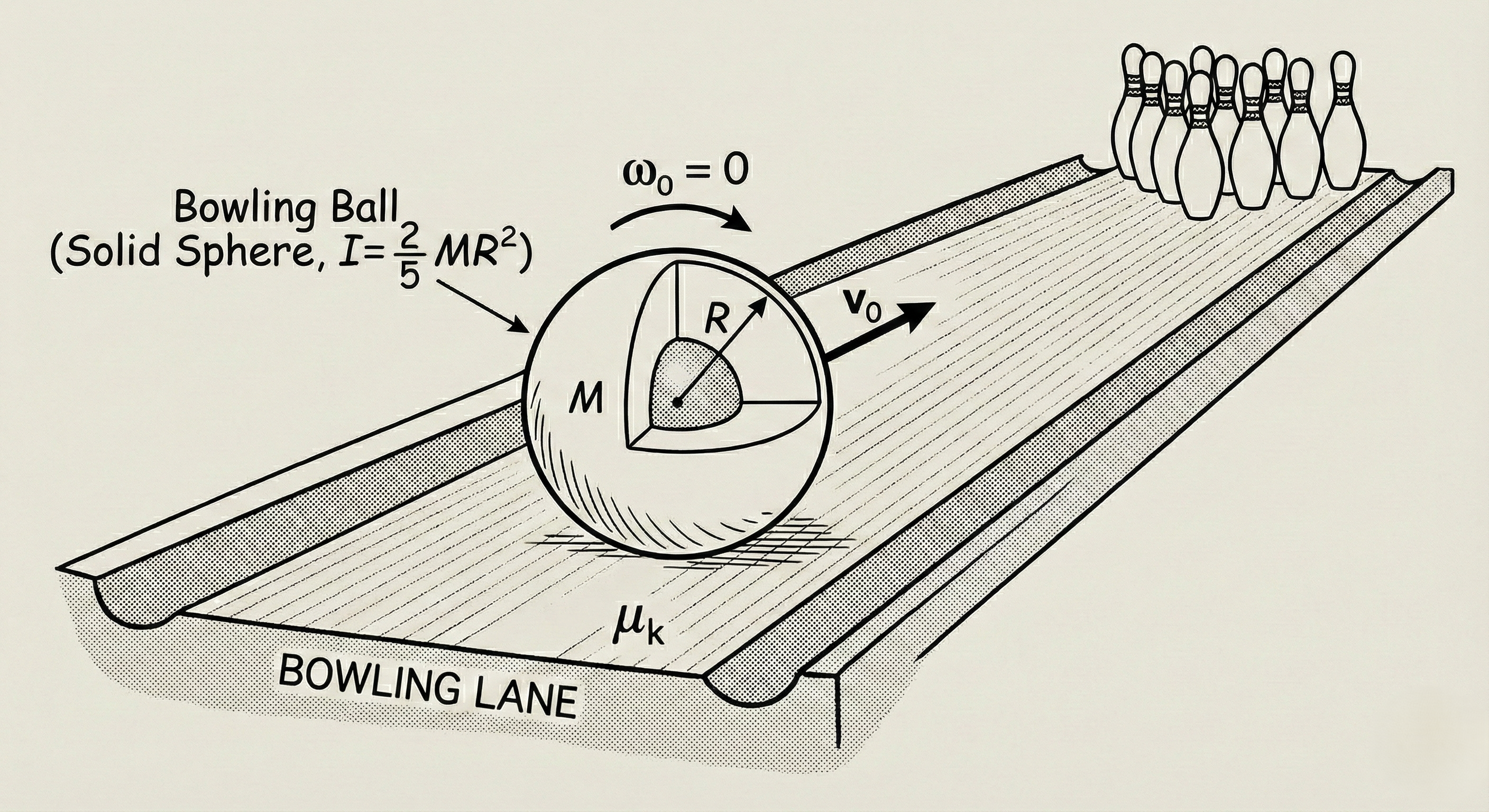
Determine the net torque on the sphere about an arbitrary point P on the lane.
Correct!
Three forces act on the bowling ball: the gravitational force acting downward at the center of mass, the normal force acting upward at the contact point , and the kinetic friction force acting backward (opposite to the velocity) at the contact point .
To find the net torque about point on the floor, we analyze each force:
Gravitational force: The weight acts at the center of mass, which is at height above the floor.
Since points vertically downward, the torque magnitude about is
where is the perpendicular distance from to the vertical line of action of , which is the horizontal distance from to the center of mass.
Normal force: The normal force acts at the contact point and points vertically upward.
Its line of action is the same vertical line as the line of action of , so it has the same moment arm . Thus its torque magnitude about is
and it is opposite in direction to .
Friction force: The friction force acts horizontally at the contact point , which lies on the floor, and point is also on the floor. Therefore, the perpendicular distance from to the horizontal line of action of is , giving
The normal-force torque cancels the gravitational-force torque, and friction contributes zero torque about . Therefore,
Want to solve all 6 parts?
Sign up for a free account to work through the complete multi-step problem with instant feedback!
Ready to Start Learning?
Sign up now to access the full Bowling Ball Down a Slick Lane lesson and our entire curriculum!