Mach-Zedner Interferometer & Quantum Interference
Unit: Quantum Computing
Later Topics
Lesson Preview
One of the most fascinating experiments that demonstrates the remarkable nature of quantum mechanics is what can be known as the Mach-Zedner experiment.
Consider the following setup:
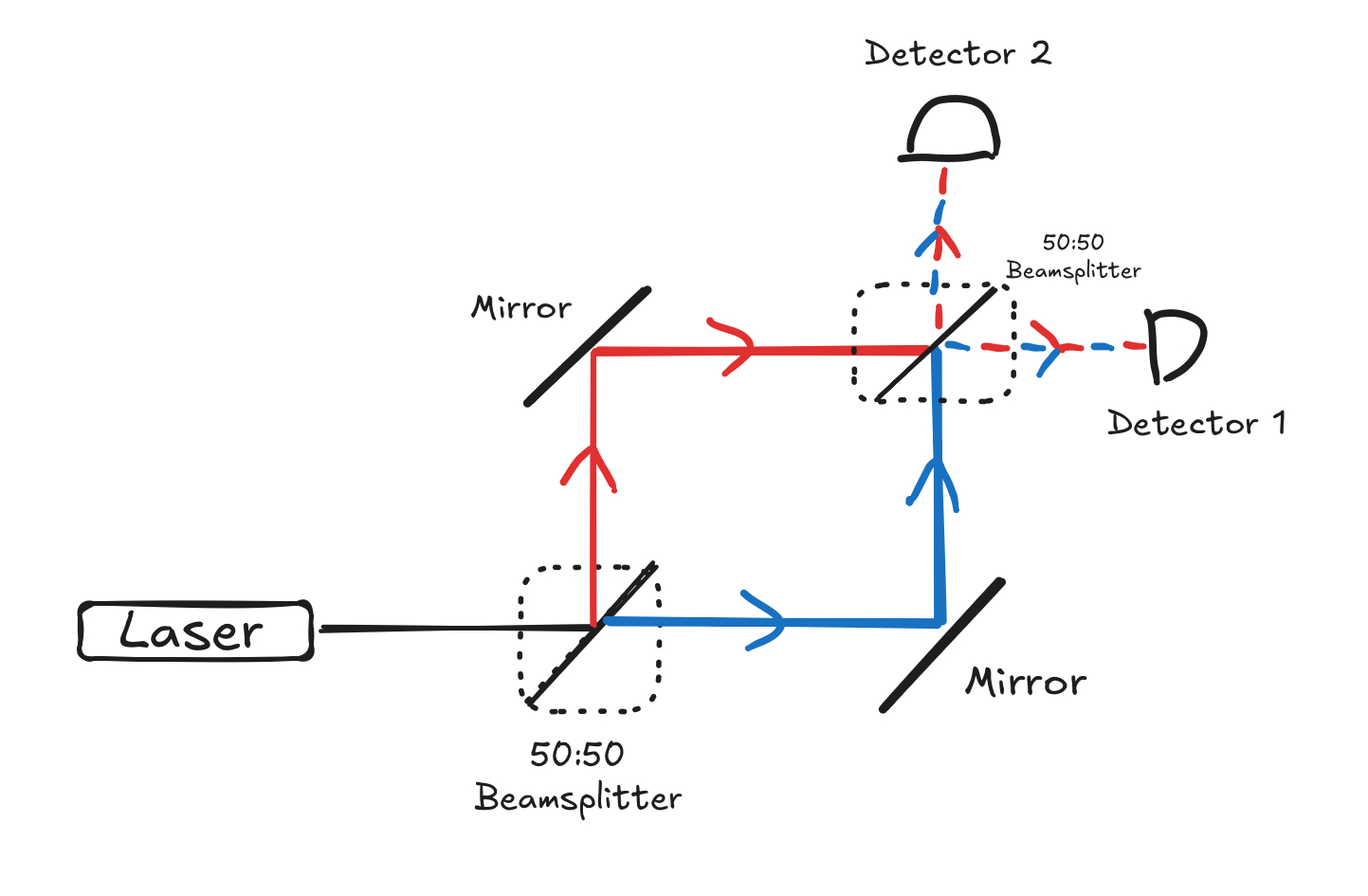
A laser is being shot at a so-called "beamsplitter", that splits the beam into two equal parts.
We know from a previous lesson that laser light is made up of photons (tiny chunks of light), and what we're about to describe holds true whether it's high intensity laser light (lots of photons) or low intensity laser light (one photon at a time). This subtlety will become important later. You are welcome, at the moment, to think of what's happening at the beamsplitter as a high intensity beam of laser light splitting in half, where half the light goes one direction, and half the other, or, as a single photon hitting the beamsplitter and going one way or the other.
Note we have color coded the two different paths, but this is not to indicate anything about the light itself, such as the laser beam splitting into red light and blue light. That is not what we're suggesting. The color simply helps to distinguish the paths.
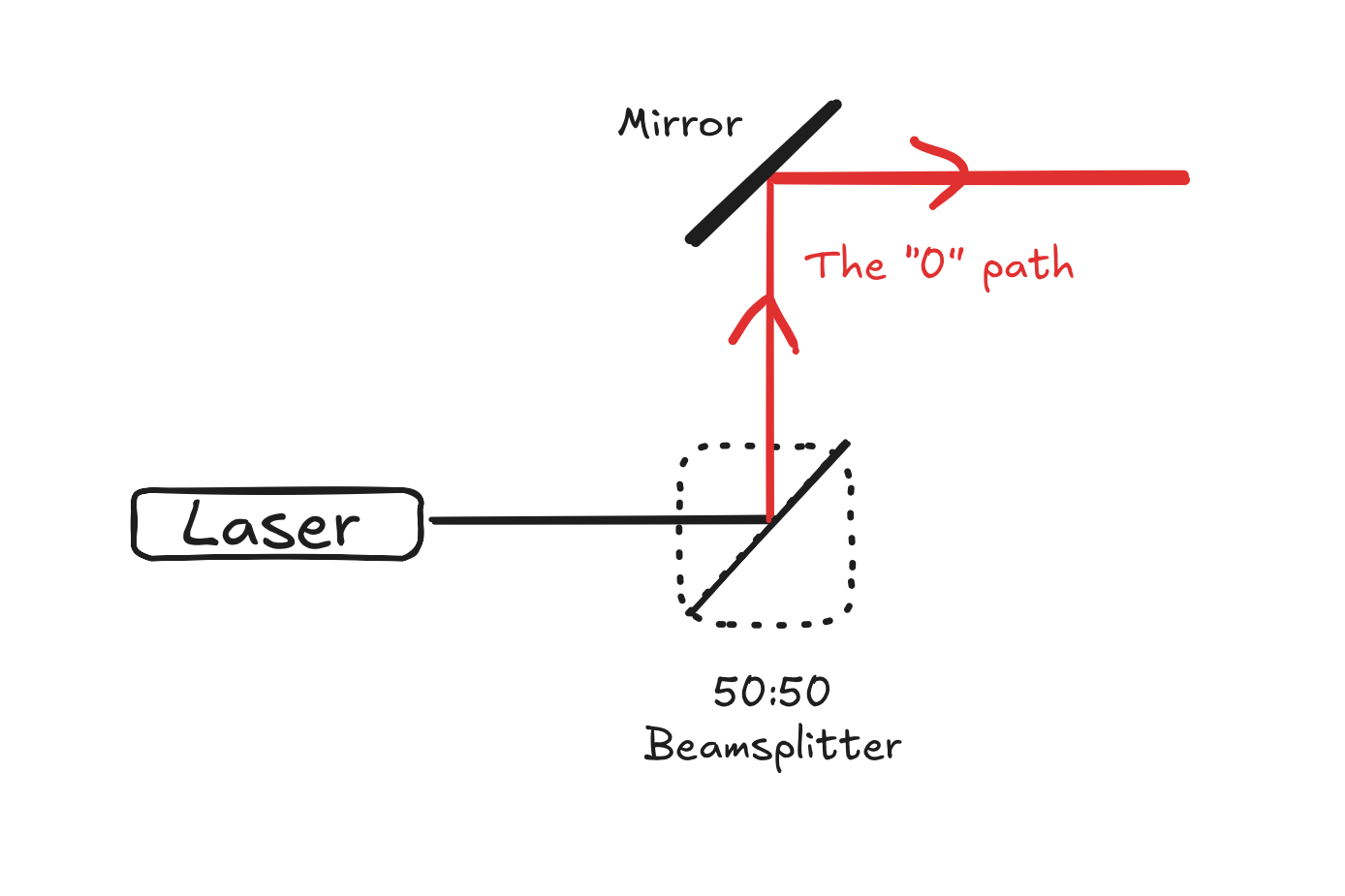
So, back to the experiment. Half the beam follows the upper path (red), which we'll also call the "" path,
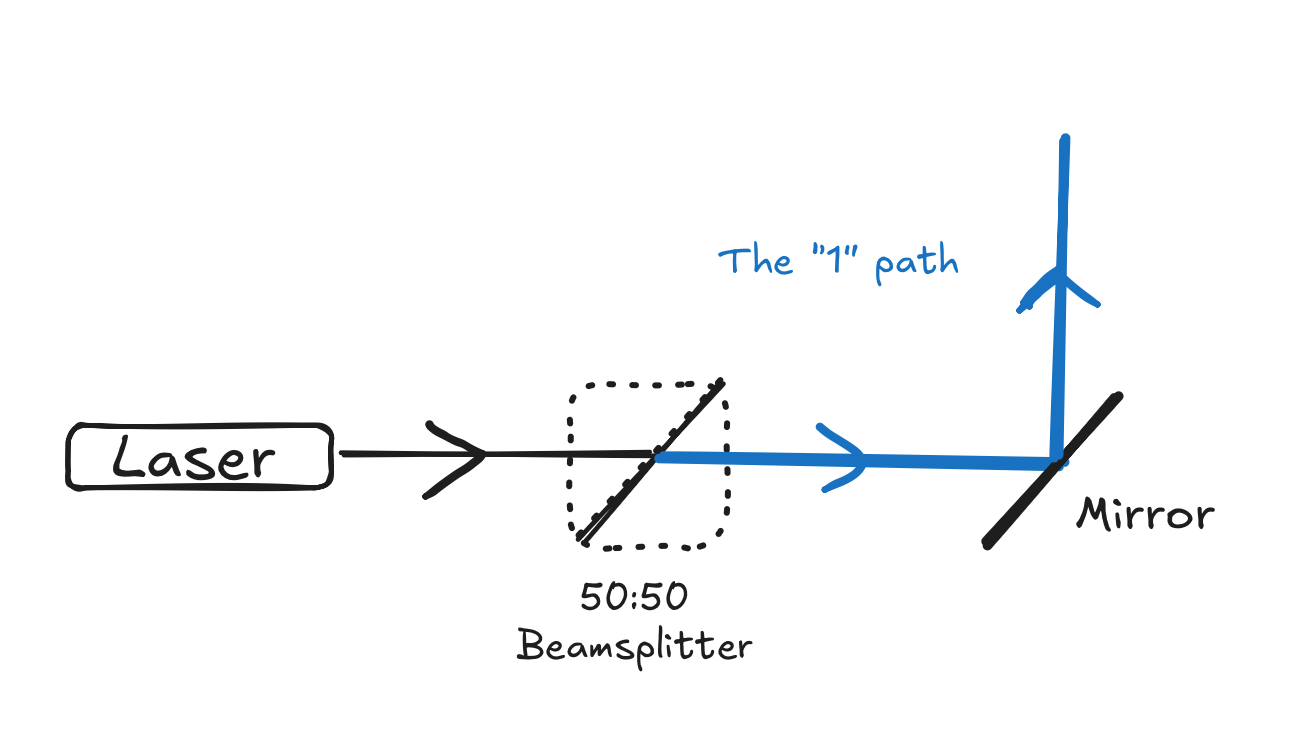
and half the beam follows the lower path (blue), which we'll call the "" path (for reasons that will become clear later).
The two beams bounce off of mirrors and are focused in again on another beamsplitter, where half of each beam is transmitted through, and half of each beam is reflected at a 90 degree angle.
Note that everything is symmetrical here, so that the beams hit the second beamsplitter at exactly the same time.
Suppose we ran this experiment, and the detector clicked every time a photon hit it.
The question is, in what rough proportion would you expect each detector to click when we run this experiment?
The answer is, classically, 50% of the clicks should be at Detector 1, and 50% of the clicks should be at Detector 2.
This matches our classical expectations, given that the beam, after beam splitter 1, is half in the upper path and half in the lower path, and after beam splitter two, each part splits again 50/50, and combines with its "other half" from the other path, so in total we get 50 percent of the initial beam going out to the right and hitting Detector 1, and 50 percent of the beam going up and hitting Detector
...
... continued in the full lesson.
Ready to Start Learning?
Sign up now to access the full Mach-Zedner Interferometer & Quantum Interference lesson and our entire curriculum!