Modelling a Pirouette
Unit: Energy and Momentum of Rotating Systems
Later Topics
Multi-Step Problem Preview
Part 1 of 5 — sign up to solve the full problem!
Part 1
A figure skater is modeled as a central cylinder of mass and radius , with moment of inertia . Two arms are modeled as thin rods, each of mass and length , with moment of inertia about their center .
Initially, the skater holds their arms extended horizontally outward from the edge of the cylinder.
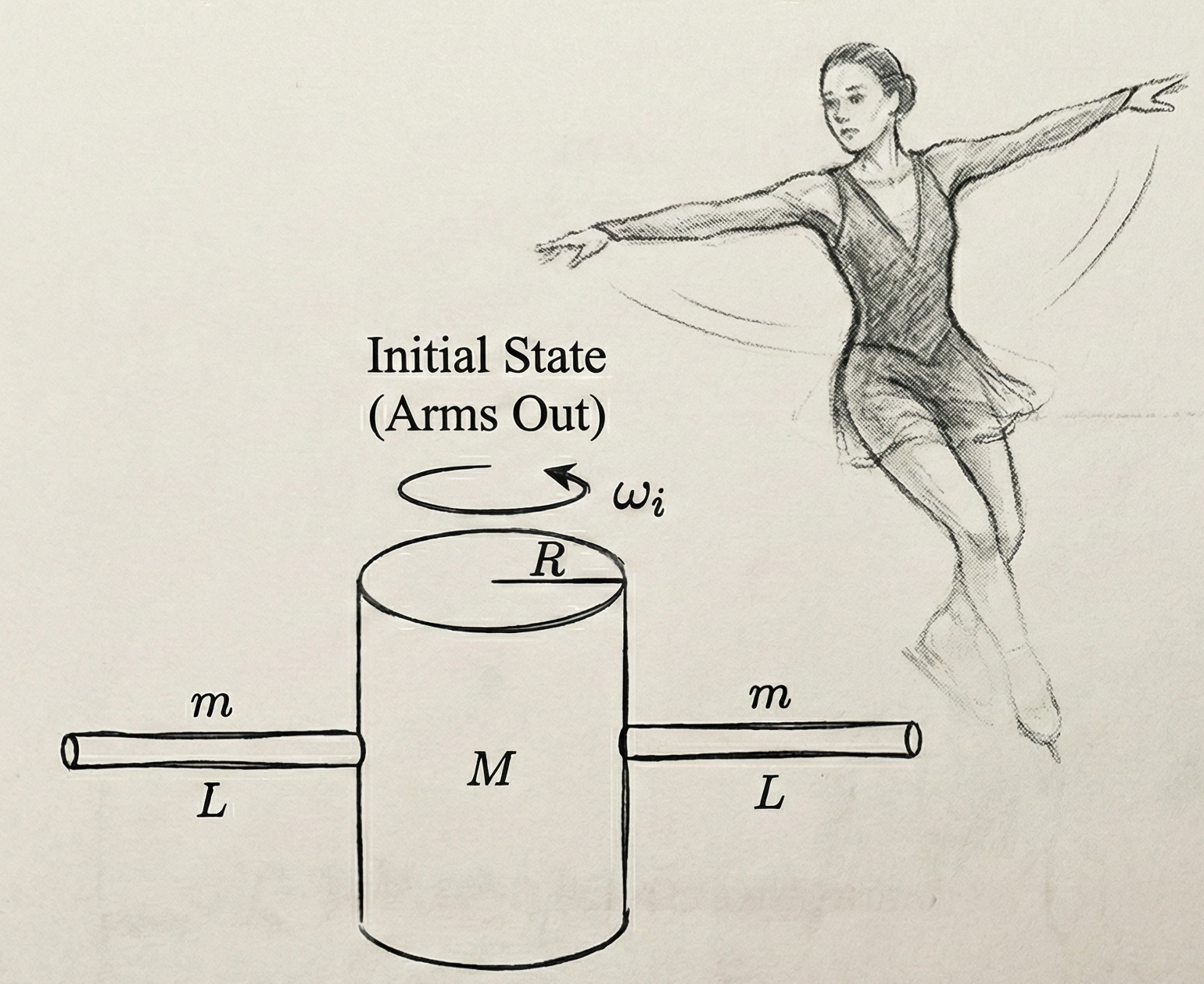
Using the Parallel Axis Theorem, derive an expression for the initial total moment of inertia of the skater.
Correct!
The total moment of inertia is the sum of the cylinder contribution and the contributions from both arms.
For the central cylinder about its symmetry axis:
For one arm (modeled as a thin rod), the moment of inertia about its own center of mass is:
The arm’s center of mass is at distance from the rotation axis, so by the Parallel Axis Theorem:
Substitute and :
There are two identical arms, so the total initial moment of inertia is:
Want to solve all 5 parts?
Sign up for a free account to work through the complete multi-step problem with instant feedback!
Ready to Start Learning?
Sign up now to access the full Modelling a Pirouette lesson and our entire curriculum!