Hockey Puck and Kinetic Friction
Unit: Force and Newton's Laws
Prerequisites
Later Topics
Multi-Step Problem Preview
Part 1 of 6 — sign up to solve the full problem!
Part 1
A hockey puck slides across a horizontal ice surface with an initial speed to the right and comes to rest after traveling a distance . Let's find the coefficient of kinetic friction between the puck and ice () with this information.
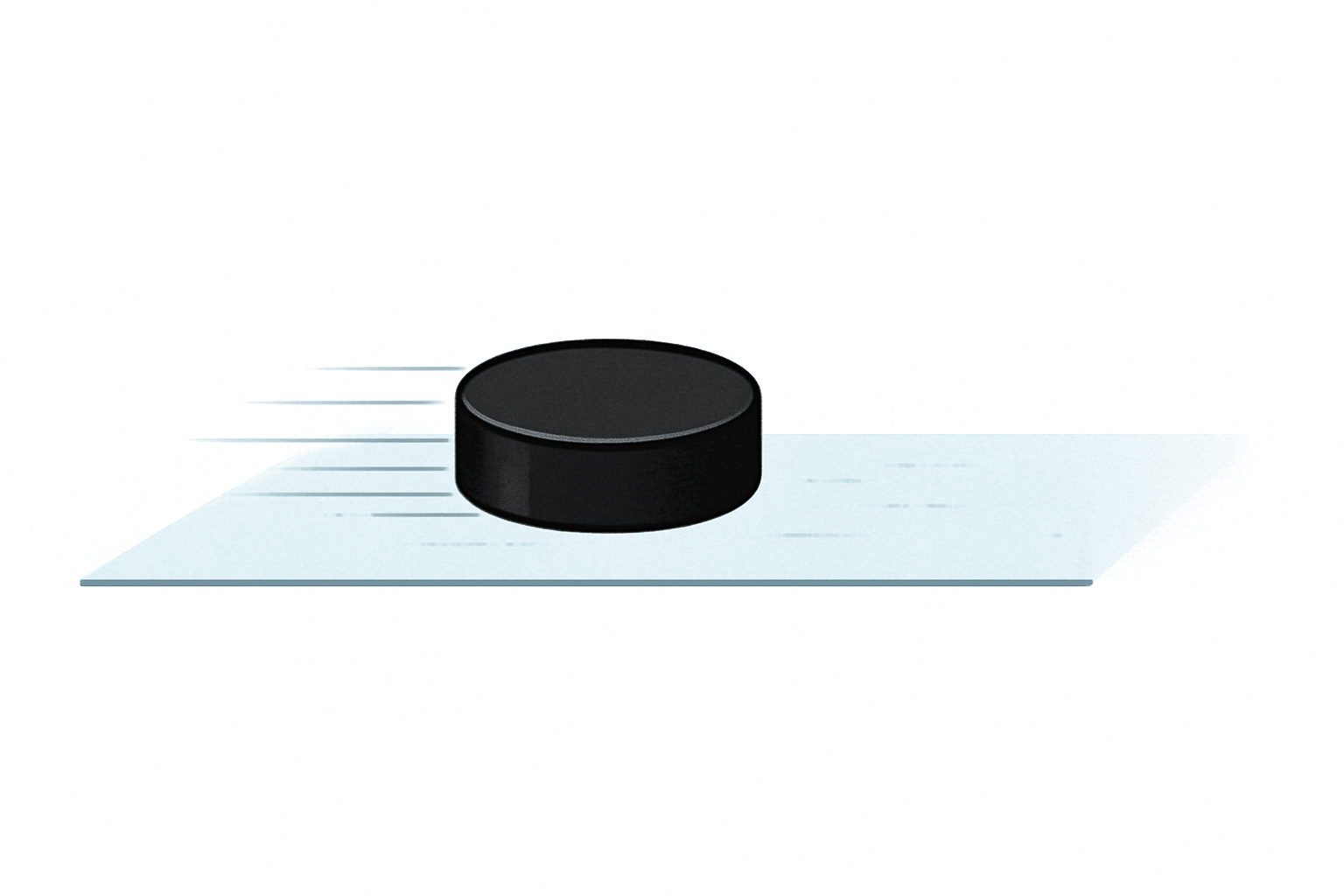
Select the correct free-body diagram for the hockey puck while it is sliding on the ice.
Correct!
Solution
The hockey puck slides on a horizontal ice surface and experiences three forces:
-
Gravitational force acts downward (toward the ice).
-
Normal force acts upward (perpendicular to the ice surface), exerted by the ice on the puck.
-
Kinetic friction force acts horizontally opposite to the direction of motion (opposing the velocity), causing the puck to decelerate.
Since the puck moves horizontally on a flat surface with no vertical acceleration, the normal force and gravitational force are equal in magnitude and opposite in direction. The only unbalanced force is the kinetic friction force, which points opposite to the direction of motion (backward if the puck moves forward).
The correct free-body diagram shows:
- pointing downward
- pointing upward (equal magnitude to )
- pointing horizontally opposite to the velocity (causing deceleration)
Want to solve all 6 parts?
Sign up for a free account to work through the complete multi-step problem with instant feedback!
Ready to Start Learning?
Sign up now to access the full Hockey Puck and Kinetic Friction lesson and our entire curriculum!