Motivation and Gamification
Game companies have spent decades studying how to keep people playing. Sometimes just for fun (like Mario or Fortnite), sometimes for pure evil (like a slot machine or a sports betting app).
At PhysicsGraph we’ve taken the tools and techniques from gaming and turned them into ways to keep you learning.
Why a PhysicsGraph lesson feels better than a textbook
In a game you press a button and something happens. Your actions make a difference. You can tell within seconds whether your situation is improving or getting worse based on your choices. In “slow” games, it can take minutes to see your results.
In the typical homework scenario, you spend an hour reading a textbook (did you understand? Who knows!), and then an hour doing practice problems, and then you wait 1-3 days to get them graded.
At PhysicsGraph, you will spend 2-5 minutes reading, then do 2-3 practice problems - where you’ll get your results immediately. You’re no longer doing endless reading or doing practice problems into the void - you’ve got a tight feedback loop keeping you motivated.
Perfect challenge level so you’re always in the flow
An important part of this feedback loop is keeping the challenge at the right level.
In school, if a student fails, the course just keeps getting harder anyways - setting them up for even more failure. Modern schools might still give the failing students As and Bs, but everyone knows the student is failing to understand the material.
In games - and in PhysicsGraph - failure results in trying again until you succeed. In addition, at PhysicsGraph we recognize where you’re having trouble and serve up extra activities to build up your skills. Then, when you get back to the activity you failed, you’re better prepared.
This results in the perfect level of challenge - what the Hungarian psychologist Mihaly Csikszentmihalyi called the flow state. It’s hard enough to keep you engaged and focused, but not so hard that you’re frustrated. It’s extremely enjoyable.
Visible progress keeps you motivated long-term
Making progress is motivating, so games have honed effective methods to show your progress clearly. This can turn a game from something you pick up every once in a while into something that you come back to daily.
- Making numbers go up
- Daily quests
- Filling up progress bars
- Progressing through a map
We use all of these.
Experience Points are earned with every successful action, fulfilling the base “number go up” drive that fuels so many gaming addictions.
Daily goals give you something achievable to shoot for every time you log in.
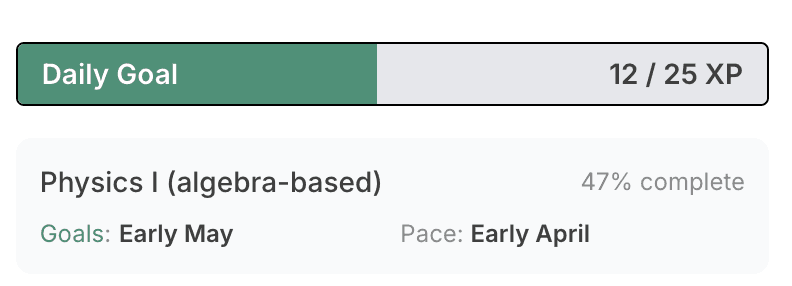
Progress bars fill up with every action you take. We’ve separated it out into individual units, so you can see them fill up much faster, and giving you a nice clear sense of progression.

Finally - and this is the one we’re most proud of - you can see your knowledge graph filling up. There’s a visible representation of everything you know. When you complete a lesson, you see the node filling up - and see what new lessons it unlocks. When you complete a review, you can see the good shading on the nodes being restored.
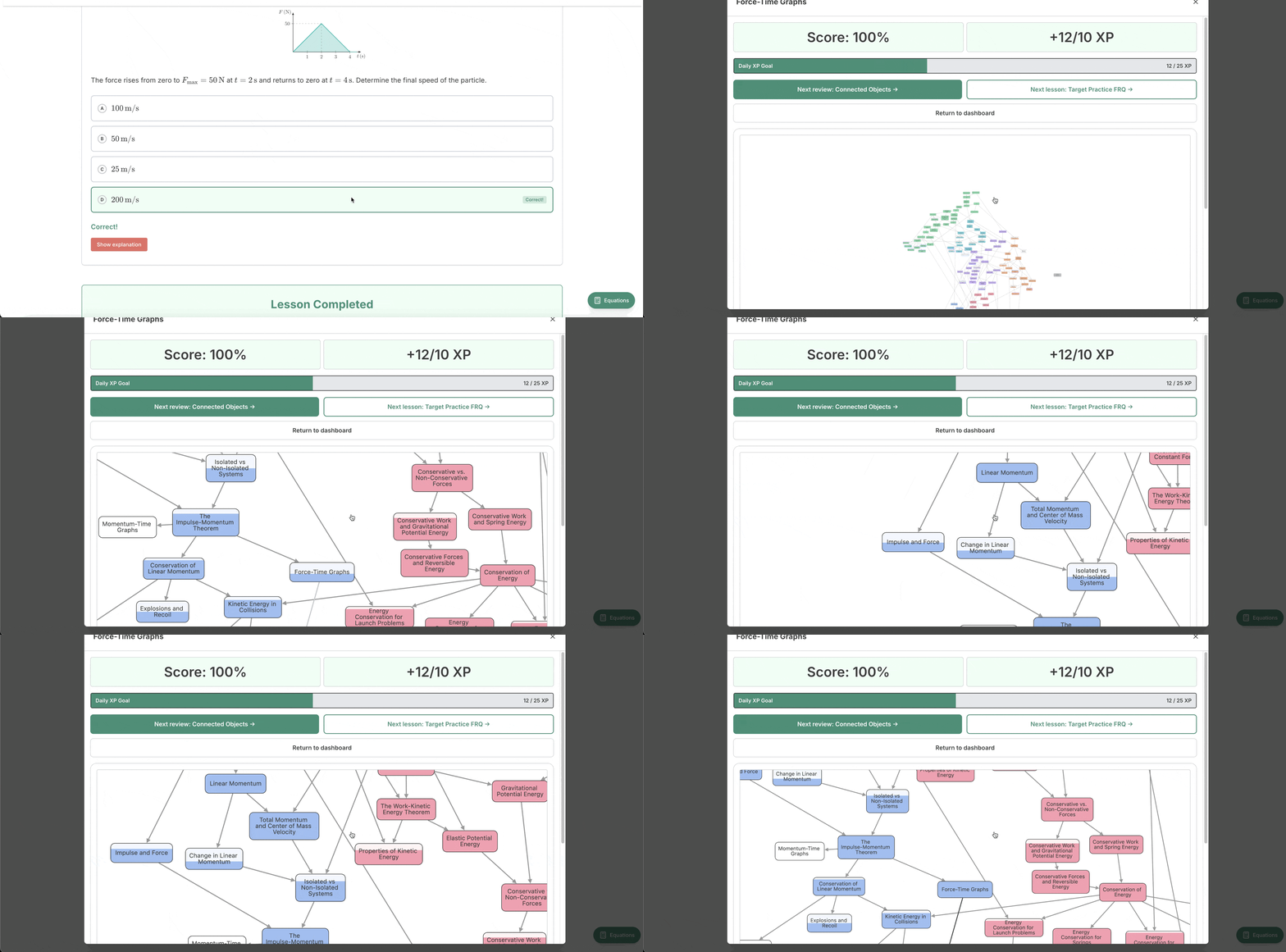
With all this together, learning becomes fun - and addictive.
Never lose sight of effective teaching
Every education company - especially if selling directly to students - has a decision to make. How much should you focus on education and effective pedagogy, and how much should you focus on entertainment and keeping people coming back?
Education vs Entertainment.
Some very successful companies like Duolingo focus on student motivation, and explicitly prioritize it over effective teaching methodology. A student who comes back will always learn more than a student who doesn’t.
At PhysicsGraph, we do as much as possible to make the experience compelling as long as it doesn’t interfere with teaching.
What this means in practice is that during the lessons we focus on a tight feedback loop and explicitly avoid anything flashy or distracting. Then, after finishing the lesson, we layer on as many reward systems as possible to keep you motivated and moving forward.
In game design, this distinction is sometimes called the “inner loop” (the moment to moment experience - in this case, doing physics or chemistry problems) and the “outer loop” (how you progress through the game - in this case, through the curriculum).
While this doesn't maximize time in app as much as putting flashing lights everywhere, we believe this is what will maximize the total amount of learning.
Start your learning habit.
Start with a 7-day free trial and use daily goals, XP, and visible progress to stay on track without guessing what to do next.