How the Knowledge Graph Works
The Knowledge Graph
The Knowledge Graph is one of the core innovations that sets PhysicsGraph apart.
Yes, it is beautiful.
Yes, it is extremely satisfying to see it fill up as you progress through the course - much like unlocking a map in a video game.
However, the most important thing the Knowledge Graph does is enable us to serve you the exact lessons and reviews that are most effective for you at any given moment.
Prerequisites
Some topics must be learned before others.
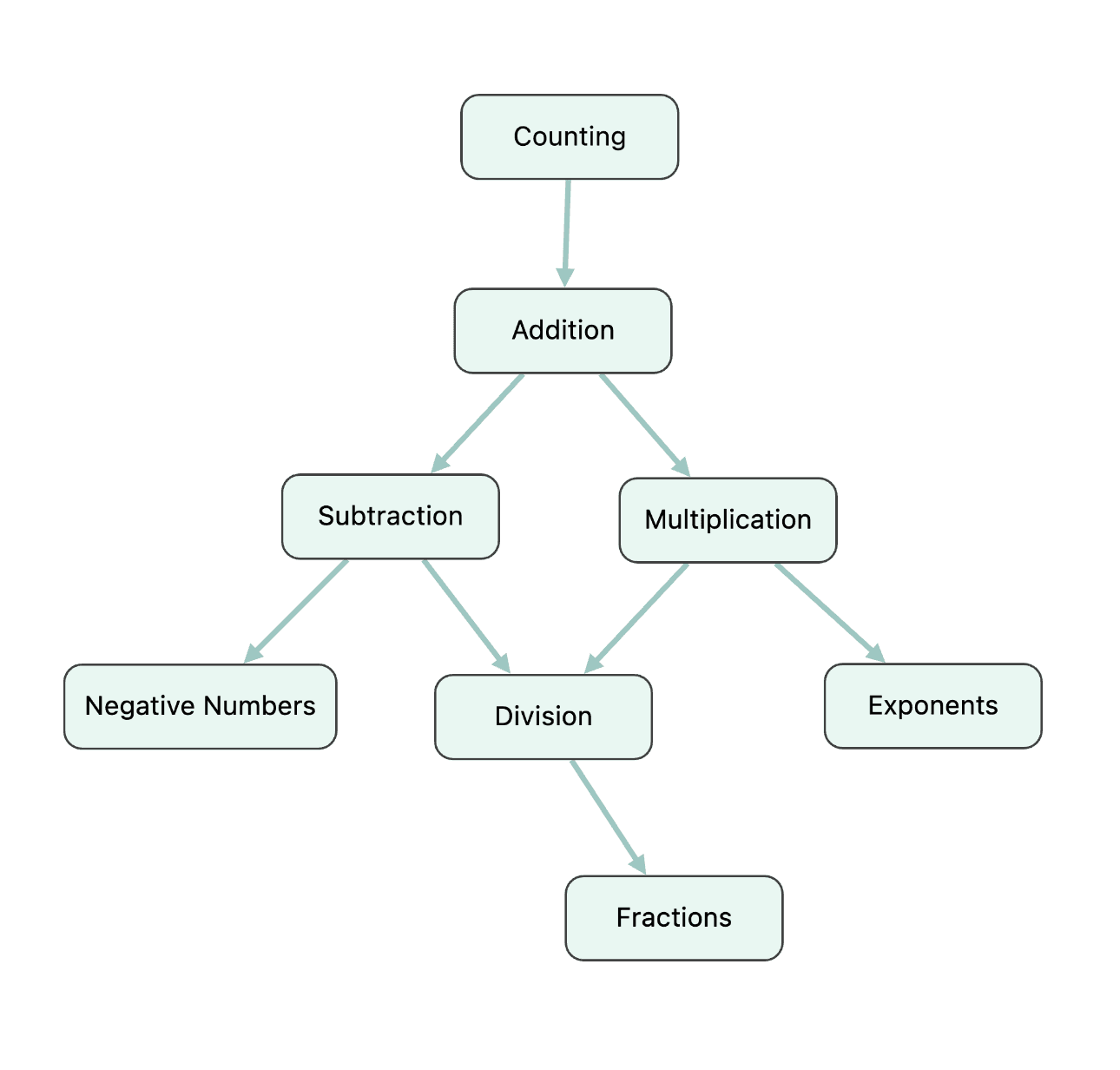
If you don't know how to count, you can't learn how to add.
If you don't know how to add, you can't learn how to multiply.
On the left you can see a highly simplified knowledge graph for some elementary math. The concepts flow naturally, and a weakness in any previous topic will make it difficult to progress further.
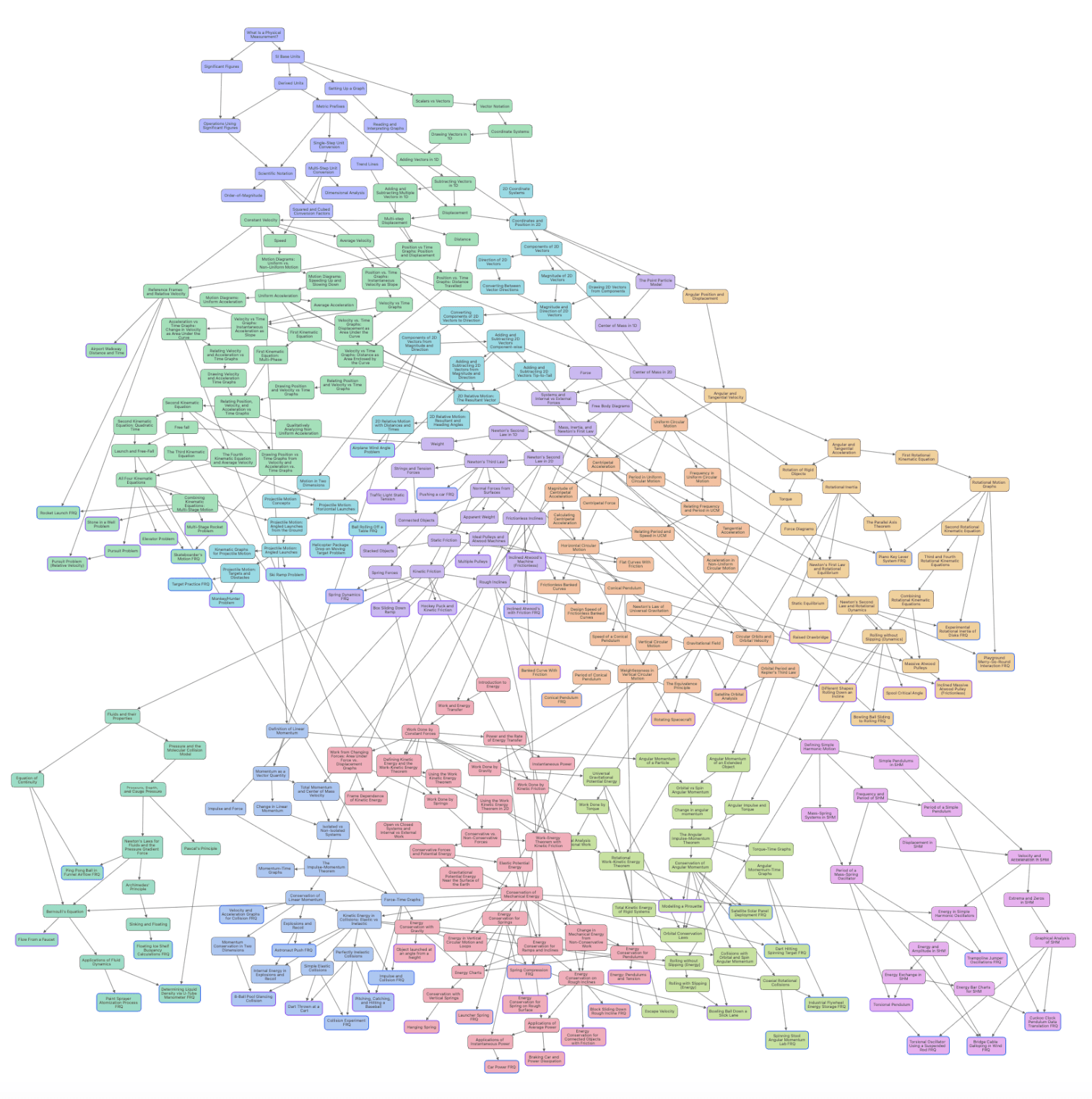
Note: our knowledge graph is much more fine-grained than this. AP Physics I currently has over 300 nodes.
Knowledge Graph vs Textbook
If you read a textbook from front to back, you will (if it's well-written) only encounter topics whose prerequisites have already been introduced.
However, it's extremely inefficient.
If what you want to learn is on page 801, you need to read 800 pages to get there - even if only 200 of those pages are actually relevant.
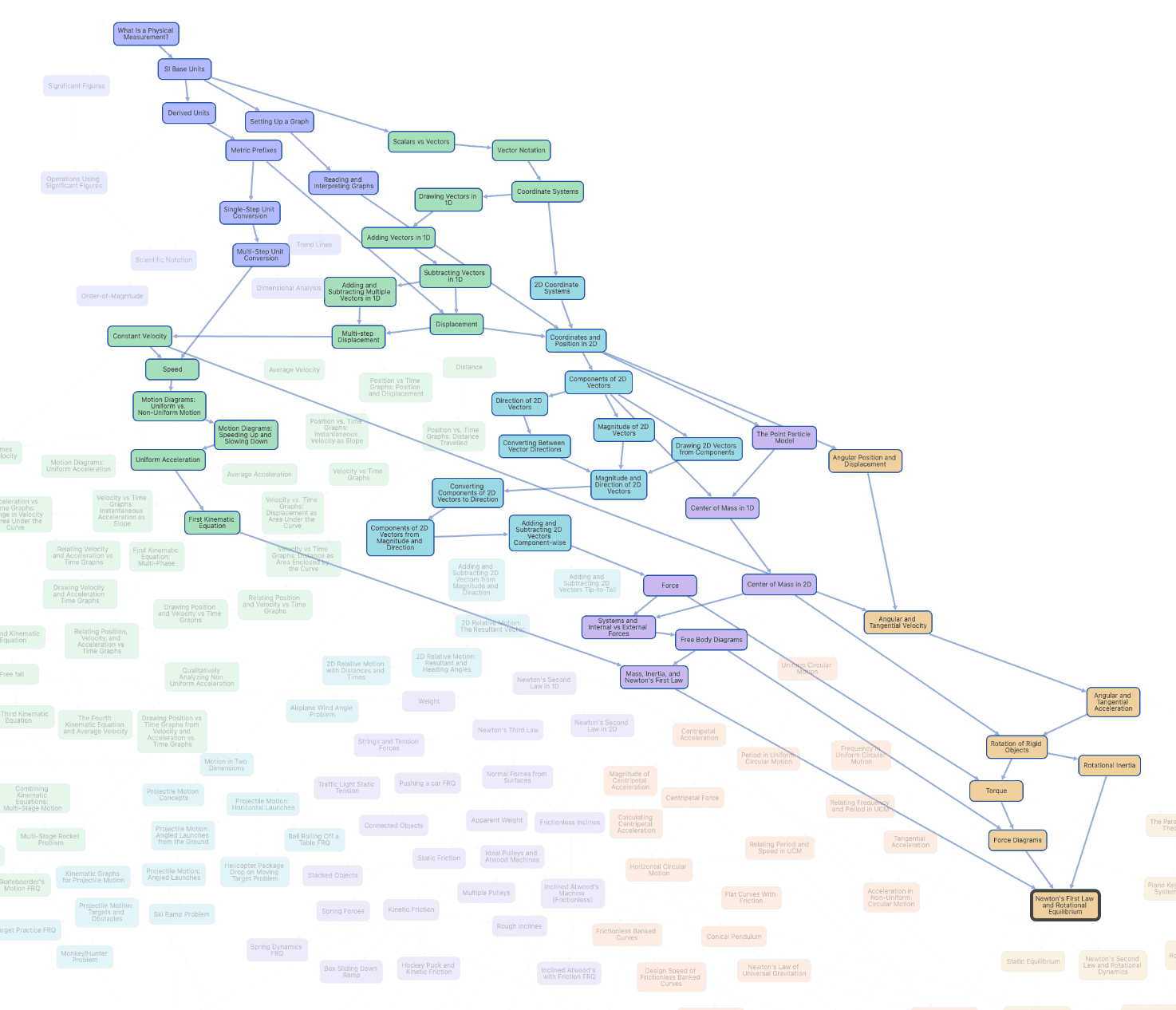
Contrast this with the Knowledge Graph - you can click any topic and see the minimum prerequisites chain. In the highlighted example from unit 7, you can see that we only rely on parts of units 0-3... and require almost nothing from units 4-6.
Efficient Review
Even if you want to complete 100% of the topics in a subject, the knowledge graph is still extremely useful. One big reason is that it allows for more efficient reviews.
We use spaced repetition to ensure that you remember what you've learned long-term. In traditional spaced repetition, you must review each topic individually on its own review schedule. This creates a very heavy review burden, especially for physics or chemistry problems that can take 30-60 seconds to solve.
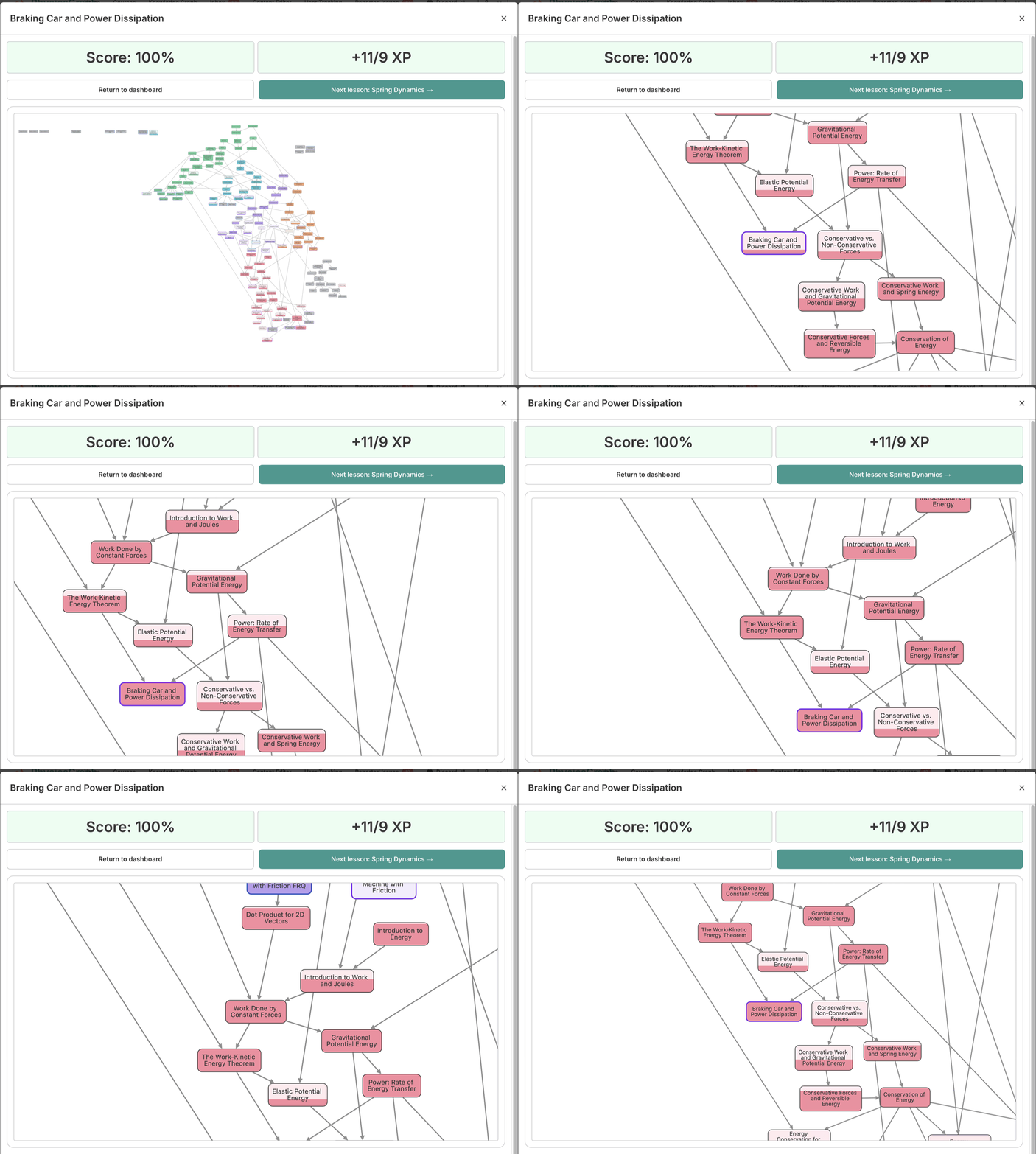
However, with the knowledge graph, we can infer that the prerequisites for that topic have also been partially reviewed. - so you don't have to waste time reviewing them explicitly. This lets you remember everything with as little wasted effort as possible.
Conclusion
The Knowledge Graph not only enables you to learn faster, it also enables more efficient reviews and better motivation.
The big weakness is that good knowledge graphs aren't constructed for most subjects, and the ones that LLMs give you tend to be very bad.
But if you're learning physics or chemistry, you're in luck. We've done the hard work, and now you can benefit.
Start your optimal learning path now.
Start with a 7-day free trial. Let the knowledge graph guide every lesson, review, and next step.