Free Response Questions (FRQs)
Free Response Questions are 50% of your AP exam score, and are a very common question type in college-level exams…
And yet most programs (if they offer FRQs at all) make you grade them yourself, or make you wait for days or weeks to get them graded - neither of which is optimal for learning.
We, on the other hand, offer dozens of Free Response Questions with:
- Accurate grading within a ~minute
- Detailed point-by-point feedback
- Integrated review based on results
- Human regrade available upon request
In addition, our questions are designed to cover all the AP question types and Science Practices, and we use the AP criterion-based scoring system, so you’ll get an experience that truly prepares you for the test.
AP Question Type and Science Practice Coverage
The AP Physics I exam has 4 question types and 3 Science Practices (or, more accurately, 10 Science Practices arranged into 3 categories).
Here are the question types:
- mathematical routines
- translations between representations
- experimental design and analysis
- qualitative/quantitative translation
Each of these question types is designed differently, as they’re meant to test different ways of applying your physics skills. For example, “experimental design and analysis” will have you writing out how you would set up a physical apparatus, take measurements, and interpret the data in an experiment.
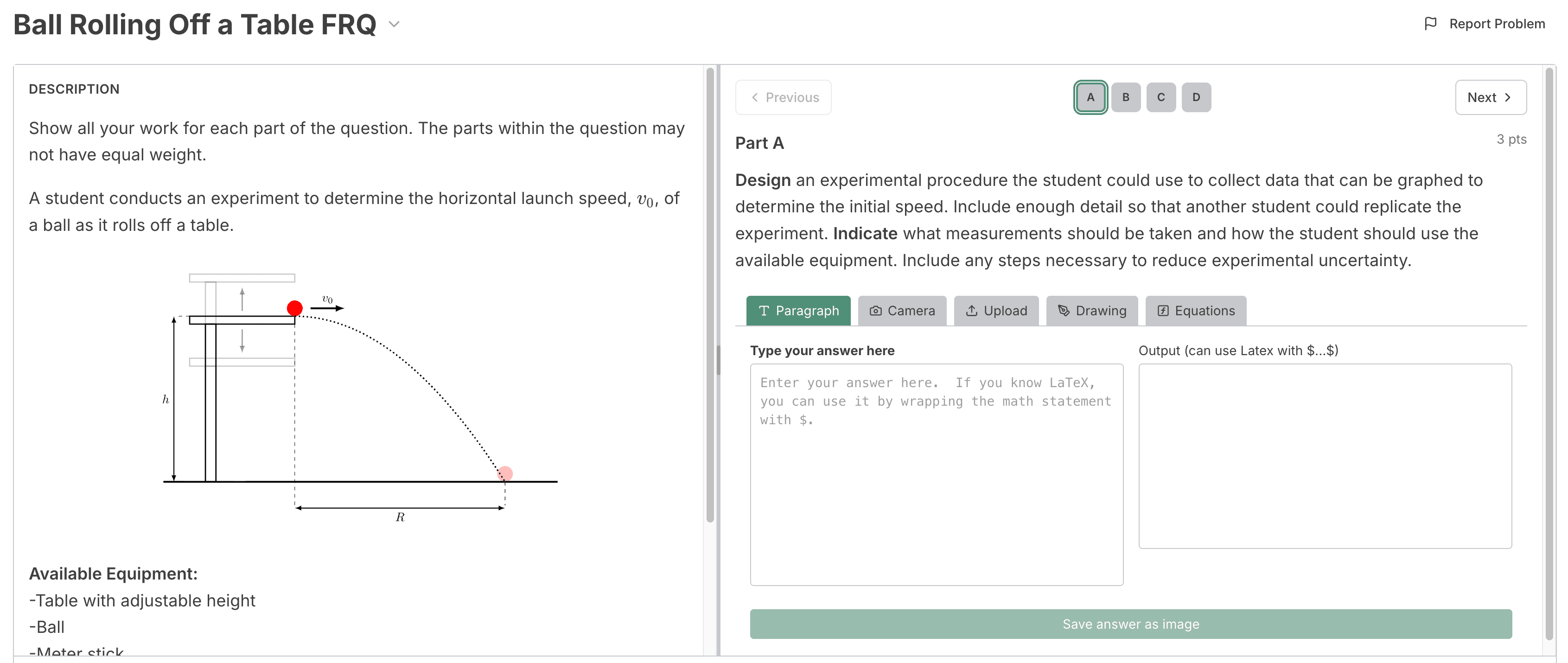
Your AP test will have one question of each type, so in order to get you sufficient practice we provide four standalone Free Response Questions - one of each type - for each AP unit.
We also make sure to cover all the AP Physics 1 Science Practices:
1. Creating Representations
- 1.A — Create diagrams, tables, charts, or schematics to represent physical situations.
- 1.B — Create quantitative graphs with appropriate scales and units, including plotting data.
- 1.C — Create qualitative sketches of graphs that represent features of a model or the behavior of a physical system.
2. Mathematical Routines
- 2.A — Derive a symbolic expression from known quantities by selecting and following a logical mathematical pathway.
- 2.B — Calculate or estimate an unknown quantity with units from known quantities, by selecting and following a logical computational pathway.
- 2.C — Compare physical quantities between two or more scenarios or at different times and locations in a single scenario.
- 2.D — Predict new values or factors of change of physical quantities using functional dependence between variables.
3. Scientific Questioning and Argumentation
- 3.A — Create experimental procedures that are appropriate for a given scientific question.
- 3.B — Apply an appropriate law, definition, theoretical relationship, or model to make a claim.
- 3.C — Justify or support a claim using evidence from experimental data, physical representations, or physical principles or laws.
Our full coverage of these Science Practices is important, since each has different ‘gotchas’ that you can’t prepare for just by knowing the core concepts and answering multiple choice questions. For example, no multiple-choice question will make you remember to label the units on your graph!
How we get accurate grading
The AP tests give criterion for each point, and then their graders assess each answer for how many of those criterion they fulfill. The criterion can be things like “correctly labeled the graph axes, including units” or “used Newton’s laws in the derivation”.
This format was created in order to increase consistency across hundreds of graders. That also makes it possible for AI to grade it accurately!
We’ve carefully refined our pipeline, defined our criterion, and selected the AI model so that we get highly accurate and relatively fast grading results, along with detailed feedback per point explaining why your answer did or didn’t fulfill the criteria.
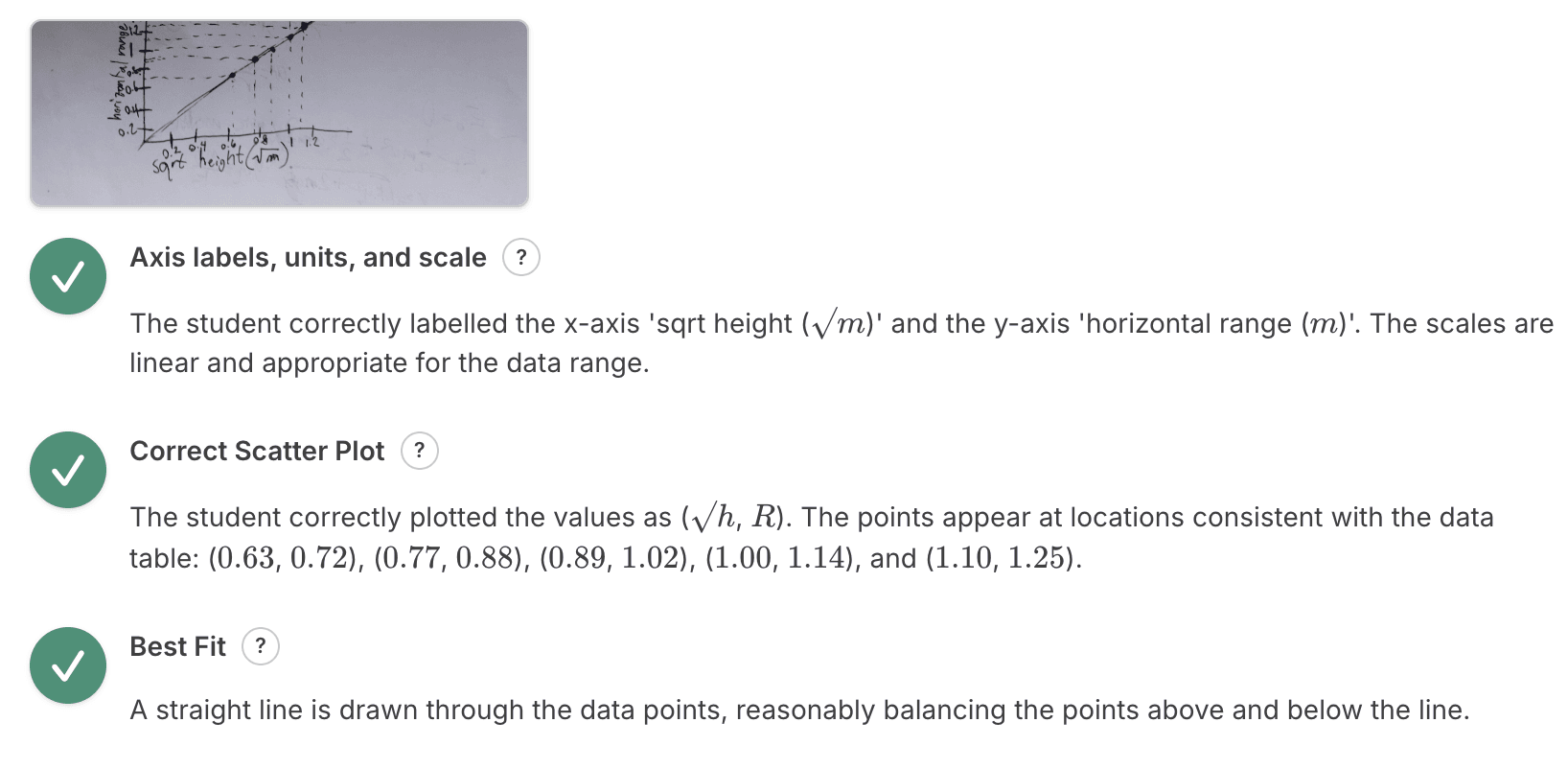
And finally, as a fallback, you can always request that a human regrades your answer. Our human graders don’t reference the AI’s grading during their work, and we will add any discrepancy in the grades to our evaluation framework so that the grading improves in the future.
Replicating the AP test input experience
The traditional way of answering these questions is to write your answer on a piece of paper - and we offer that option. You can write it down, then snap a picture of your work.
However, many questions only require writing a paragraph or creating a simple drawing, and for those we’ve added alternate ways of inputting your answer that are far more convenient.

- Paragraph Input
- Equation Keyboard
- Drawing pad
- Image upload (so you can use any input program you want)
Prepare now
Free Response Questions are what catch many test takers by surprise, so you should start preparing now.
At PhysicsGraph, we first make sure you have all the concepts needed for an FRQ mastered, and then we give you the FRQ itself to get you practice with the format.
In addition to the standalone FRQs for each unit, we also have four FRQs included in each practice test.
Prepare for how graders actually grade.
Start with a 7-day free trial and get point-by-point FRQ feedback before those habits show up on test day.